
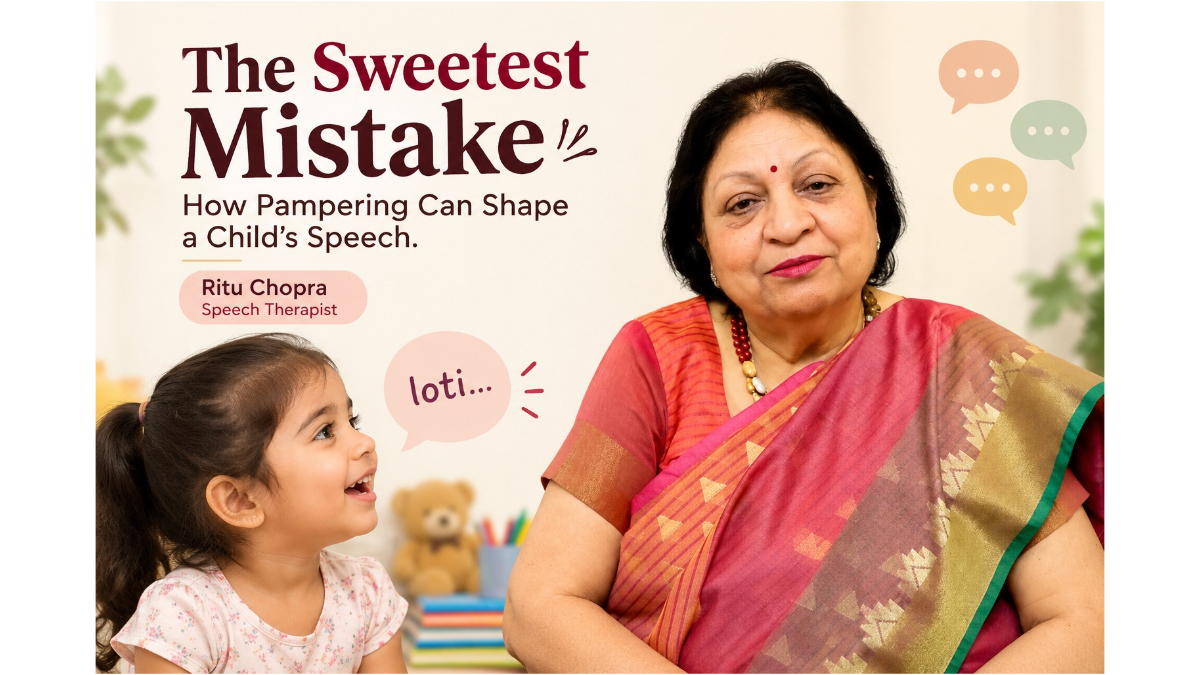
Ritu Chopra, Speech Therapist
New Delhi [India], October 19: A child’s clear speech is not a gift of nature alone; it is built, sound by sound, by the people who love that child most.
Picture a three-year-old running in, eyes shining, asking for “loti” when she means roti. The whole family melts and repeats it.
No one is doing anything wrong; everyone is simply enjoying innocence. Yet that tender moment, repeated a hundred times, can plant a habit that follows the child into the classroom and beyond.
The Charm Trap: When Pampering Locks In a Mistake
A child learns language the way a sapling grows: by leaning towards the light. For a young child, that light is the face of a parent, a grandparent or a teacher.
When the mispronounced word earns laughter and applause, the child concludes: this is the right way to say it. When he says it correctly, the reaction is ordinary, so he may return to the “wrong” version that makes everyone smile.
Think of the playful line on Indian wedding cards: “Mere mama ki shaadi mein jalool aana.” Charming on a card, but “jalool” is not a word.
A child’s early speech is like wet cement. Smooth a footprint today and it costs nothing; leave it for a few weeks and you need a chisel. Every affectionate repetition of a mistake is a footprint left to set.
One Sound, a Whole Chain
Hindi sounds come in families. K, kh, g, gh are made at the back of the tongue; t, th, d, dh near the teeth. A child who cannot produce k usually struggles with its neighbours too: kahani becomes “tahani”, kursi becomes “tursi”, ghar becomes “dhar”.
It is like a loose thread in a sweater: pull it and the whole row unravels. The encouraging part is the reverse. Fix the root sound, and a whole row of words straightens itself out.
Mother Understands; the World Does Not
At home, a mother becomes a fluent translator. She knows “mamm” means water and “tela” means kela.
But the translator only helps while she is in the room. In a playgroup or at school, other children don’t understand; some laugh. The child, once the star of the family, may grow shy and withdrawn.
The clearest alarm rings during school dictation. A child writes what he speaks, not what the teacher says. If he says “taam” for kaam, he writes “taam”; he cannot write a sound he has never produced.
The lesson: don’t wait for the notebook. Listen to your child the way a stranger would.
How Clear Speech Is Rebuilt
1. Test precisely. Parents usually believe the child has trouble with one sound; a careful assessment almost always finds more.
2. Follow nature’s order. Lip sounds first (pa, ba, ma), then tongue-tip sounds (ta, da, na), then back-of-the-tongue sounds (ka, ga).
3. Place the tongue correctly. Every sound has a home in the mouth; the child learns where the tongue should sit and how it should move.
4. Move from sound to word to sentence. A sound learnt alone is like a cricketer who only plays in the nets; it must be tested in a real match.
5. Practise until it is permanent. The goal is speech so well practised that the child could not say it wrongly even if he tried.
Don’t Spoil Your Own Language
A child is a mirror, not a filter. Whatever language we give, correctly or carelessly, the child reflects back. Children are recording long before they are replying, so the discipline lies with us: complete words and correct pronunciation, every day.
A simple shift in practice
When your child says “tela” instead of kela, don’t repeat the mistake and don’t scold. Smile, and calmly echo the correct form: “Haan, kela! Tumhe kela chahiye?” The child hears love and the right word at the same time.
Myths Versus Reality
Stammering (hesitating on or repeating words) can appear at any age. Mispronunciation usually begins at the very start, because the child follows the pattern the family set.
In some homes, a child is fed food a crow has pecked, in the belief that it will make him talk clearly. It does nothing for speech and can carry infection, making the child ill. Comfort rituals are not treatment.
Acceptance: The Seed Does Not Sprout Overnight
Some children produce a missing sound within the first minute of guidance, but turning it into a lasting habit takes time, depending on how many sounds are affected. A gardener who digs up a seed every morning to check its progress will never see it grow. Trust the process and celebrate small wins.
Your Words Become Their Voice
• Enjoy the innocence, but don’t echo the error.
• Speak in full, correct words yourself.
• Listen like a stranger, and take unclear speech seriously.
• Seek a proper assessment early, before dictation reveals the problem.
• Replace rituals with practice at home.
A clear voice brings confidence in the classroom, ease among friends and courage to express ideas. That voice is built at the dinner table, on a grandparent’s lap and in a hundred small daily conversations. Our love gives children the wish to speak; our words give them the way to speak well.

Give Your Child the Gift of Clear Speech
Every child deserves to be heard, understood and confident. If your child’s speech is unclear or certain sounds are difficult to pronounce, don’t wait for the problem to affect their confidence or learning.
Seek a professional speech assessment and take the first step towards clearer communication. With the right guidance, consistent practice and family support, your child can develop speech skills that last a lifetime.
Take the first step today. Connect with Ritu Chopra, Speech Therapist, for guidance and support.
Website: https://MySpeechTherapist.in
Email: [email protected]
WhatsApp (Message Only): +91 98185 35551
If you object to the content of this press release, please notify us at [email protected]. We will respond and rectify the situation within 24 hours.